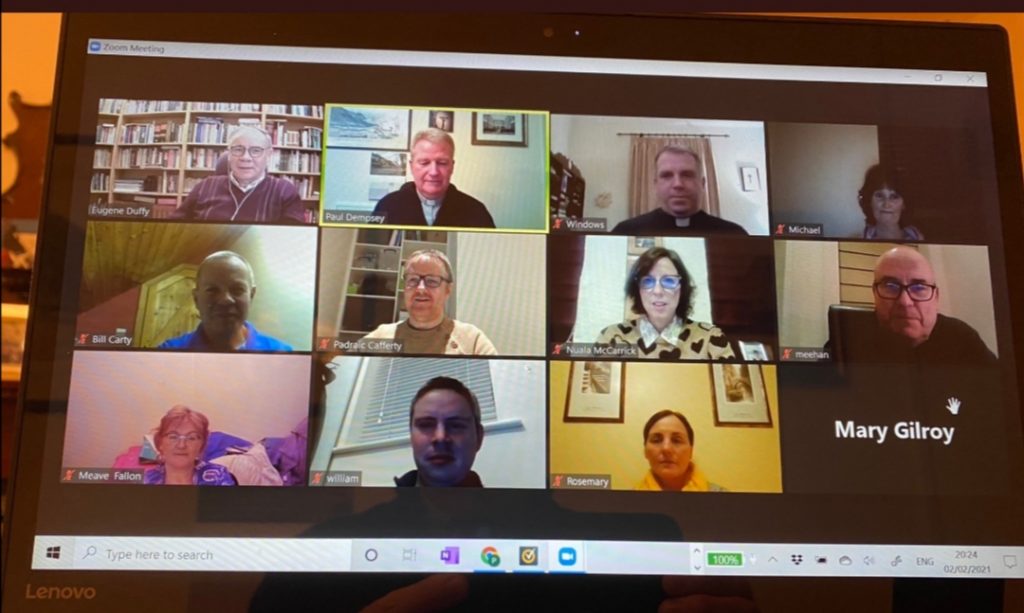
On Tuesday, 2nd of February, the newly formed Pastoral Leadership Team met via “Zoom.” The group is made up of nine lay people, three priests and myself. For our first meeting I set the scene for the group as follows…
I was parish priest in Newbridge for five years, before that I served in other parishes in Co. Kildare and worked in the areas of youth, vocations, and local media. Then, one day, out of the blue, I was appointed Bishop of Achonry. For me it is a very different role, in a different diocese, in a different part of the country. It is a role that has many challenges and there is no blueprint with clear answers. I am very aware that I need help, advice, and guidance in my role as shepherd of the diocese. With this in mind, I went about forming a group of people so that we can work together to reflect upon the challenges that face us as a diocese today and see how we might meet those challenges.
Co-responsible
Over the years I worked with people in parish life, I now felt I had a great opportunity to develop this in my ministry as bishop. Pope Benedict while talking to a group of pastoral leaders a number of years ago said that people were “co-responsible” for the life of the Church. This was a very significant statement. Over the years the responsibility for the leadership of the Church tended to be left to the priests and bishops. Pope Benedict was saying that all baptised Catholics are equally responsible for the life of the Church. Pope Francis emphasises “synodality” in the Church. This unusual word literally means a “journeying together” or “walking together,” discerning where the Spirit may be calling us.
From this I see the Pastoral Leadership Team as a group of people, priests, and bishop “walking together” trying to discern and reflect on where the Spirit is calling us in the diocese at this time and how we can respond to that call? The Team is made up of people from around the diocese. They were recommended by priests. They do not perceive themselves as being experts! However, each one has rich life and parish experience and are committed to their faith. I thank each one for the generosity in giving of their time and energy to this initiative.
The Journey from here…
We are fortunate to have Fr. Eugene Duffy as a resource in the diocese. Fr. Eugene is from Ballaghaderreen and lectures in theology in Mary Immaculate College in Limerick. Over the next couple of months, Fr. Eugene will be sharing his expertise with the group on various topics that are essential to ministry. These include: How God speaks to us and how we respond, the mission of Jesus, the mission of the Church, roles and ministries in the life of the Church. After these sessions we will then begin to reflect in a deeper way on the next steps. It is important to emphasise that this is not in any way a “closed” group! We will be communicating with the people and priests of the diocese. Communication is a two-way process, so people can always get in touch with their reflections and ideas at any time.
As we take these initial steps, I ask you to pray for this initiative. We are setting out on a journey, not too sure where the destination is! We trust in the Lord as we “walk together” knowing that his love and light will guide us along the path he wishes us to follow.
Knock Shrine to host special online faith discussions during Lent
Ash Wednesday falls on 17 February and heralds the beginning of Lent 2021. This year Knock Shrine will host a new series of online discussions to help engage Christians during Lent, under the title ‘Living Christian Faith – Lenten Conversations’.
What nurtures our faith and what challenges it today?
Where do we find hope and joy in our lives?
How can our faith build mental strength, wellbeing and resilience?
How has the Covid pandemic impacted upon our faith?
These are just some of the questions that will be explored over the 6 weeks of Lent during a new series of online discussions on the topic of ‘Living Christian Faith’. Faith Renewal at Knock Shrine is all about reaching out to people. This will open a conversation on contemporary issues of faith and church life.
Chaired by Father Eamonn Conway DD, Priest in Tuam diocese and Professor of Theology at Mary Immaculate College, the conversations will explore a different theme each week and guest speakers will discuss some of the important questions we all face in living out our faith.
The discussions will be streamed online via the Knock Shrine website offering people from all over the world the opportunity to engage in relevant topics and to hear from a range of people, from those in public life such as Baroness Nuala O’Loan and Senator Ronan Mullen to groups of young teachers and members of the clergy.
Thursday 18 February‘Living Christian Faith in the Family’ Saint John Paul spoke about how the future of humanity passes by way of the family. Patrick and Linda Treacy, who have four children and run a centre for domestic spirituality called Integritas from their home, will speak about the joys and challenges of living Christian Faith as a family today.
Thursday 25 February‘Living Christian Faith as Young Adults’
A group of young Irish adults, for whom Christian Faith is of great importance, will discuss the strength it gives them and how we can better communicate the joy of the Gospel today.
Thursday 4 March‘Living Christian Faith in the Classroom as Young Teachers’
Three recently qualified primary teachers explain how their religious faith is important to them and how it influences their work as teachers in the classroom.
Thursday 11 March‘Living Christian Faith in Public Life’
Baroness Nuala O’Loan, Senator Ronan Mullen and discuss their own faith, how it informs their public service and the challenges people of faith encounter in the public sphere today.
Thursday 18 March ‘Proclaiming Christian Faith as a priest or religious today’
Sr Ursula Lawler, lecturer in Christian Ethics at Mary Immaculate College, returned missionary and editor of the Africa Magazine, Father Sean Deegan SPS; Ballyhaunis Parish Priest Father Stephen Farragher and Father Eamonn Conway will discuss living priesthood and religious life today in conversation with young Irish Catholic journalist Jason Osbourne.
Thursday 25 March ‘Studying Christian Faith’
Máire McDonald is Vice Principal of a busy secondary school in Dublin. Judith King is an internationally recognised psychotherapist and Margaret Naughton is a busy hospital chaplain. Yet they have all found time to fulfil their passion of doing a PhD in theological studies. They share with us how their theological studies enriches their faith and their work.
The talks will be streamed at 8.30pm every Thursday during Lent.
Bishops’ Conference statement: “Welcoming vaccines for the Common Good”
The Irish Catholic Bishops’ Conference welcomes the encouraging news that a number of vaccines for COVID-19 are at an advanced stage of preparation and are likely to be available for use in the near future. The Catholic Church recognises that safe and effective vaccination is an essential aspect of the prevention of disease. We are encouraging Catholics to support a programme of vaccination, not only for their own good, but for the protection of life and the health of those who are vulnerable and for the common good of humanity.
Questions have arisen that human foetal cell-lines, which have their origins in abortions carried out in the past, are used in the development and production of some of the vaccines for COVID-19.
If a more ethically acceptable alternative is not readily available to them, it is morally permissible for Catholics to accept a vaccine which involves the use of foetal cell-lines, especially if the potential risk to life or health is significant, as in the case of a pandemic. Refusal to accept a vaccine could contribute to significant loss of life in the community and especially among those who are most vulnerable. This reality must inform any judgement of conscience.
We note that many of the vaccines currently being developed do not depend for their design or production on foetal cell lines. Catholics should continue to advocate for the availability of ethically-developed vaccines. In that way they bear witness that biomedical research should always be conducted in a manner which is consistent with respect for life and for human dignity.
Access to healthcare is a fundamental human right. The Church, while respecting intellectual property rights, believes that essential medicines, including vaccines, should be made available on the basis of need rather than on the basis of capacity to pay. This position is consistent with the TRIPS agreement of the WTO, which permits national governments to arrange for the manufacture of essential pharmaceuticals, for domestic use and for the use of poorer countries, even without the consent of patent owners.
A Reflection by Bishop Paul Dempsey, Achonry Diocese
14th January 2021.
I am conscious as I write these words that I have no idea, nor can I even imagine what it must have been like for a young girl in Ireland to have become pregnant outside of marriage just a few decades ago. So many were abandoned by their families, their communities, their parishes, their priests, their Church, and the men who were responsible for their pregnancy. The loneliness, the shame, the fear, the angst, the sheer terror is beyond my comprehension. The Commission of Investigation into Mother and Baby Homes Report goes to three thousand pages. It would be impossible for me to cover all the issues it raises. However, the general tenor that emerges within its pages is of a society that was cold and uncaring. We could all too easily blame “society,” but as a member of the Church, and a leader in that Church, I face the difficult reality that it was a society which was deeply influenced by the Catholic Church.
In their apology, the Bon Secours Sisters, who ran the Tuam Mother and Baby Home, stated that they “did not live up to their Christianity.” It seems that so many during that period of Irish life “did not live up to their Christianity,” even though we were a nation that prided ourselves on being a good Catholic country. It seems that we may have been good Catholics, but we were not such good Christians. The question has been asked: “How could this happen?” How could we be so cold, so cruel to our daughters, our sisters, our friends, our neighbours? One explanation was that the Church had a distorted view of sexuality that seemed obsessive. Instead of seeing sexuality as a beautiful, sacred gift, created by a loving God, it was considered something secretive and taboo, something not to be talked about. Anyone, who through human nature, was viewed to have made a mistake, was shunned. Sins of a sexual nature seemed to be the only sins one could commit, there was little focus on other immoral issues such as domestic abuse or fraud. There is no doubt, and it is truly shameful, that the Church during this time lost its focus, which should always be Christ. When the Church fails to focus on Christ, all sorts of distorted practices emerge. It seems that one of those distorted practices was exercising an unhealthy power over people’s lives, especially in the most intimate areas of life.
Unfortunately, we cannot change the past, but we can learn from it. This, perhaps, is where we can draw some hope. The Tánaiste, Leo Varadkar, stated that; “we should not lose sight of the more hopeful story that is told in the Commission’s report as well. It tells the story of a country that has changed and progressed, that got better, kinder and more compassionate, more loving, less judgmental and less misogynistic as the years passed.” I believe this is generally true, but in my own ministry over the years, I have come across many people who lament the direction our country has taken. They feel it has become far more secular, with fewer numbers attending Mass and they believe there is an agenda to rid society of the influence of the Church. In the light of the Mother and Baby Homes report and the numerous reports that preceded it, is it any wonder people would want to rid the country of the Church that is portrayed? I believe there is a more hopeful message in there for the Church too. The publication of so many painful reports has exposed us to the truth. Jesus Christ tells us; “The truth will set you free” (Jn. 8:32). It is important to acknowledge that it was the “secular” world that has called the Church to account and made us face the truth. Surely this is a good thing and God has to be at work in it?
In my experience the Church has become a more humble, more compassionate community today. It no longer holds an unhealthy, powerful grasp on society. The Church has its teaching, a teaching that is inspired and revealed by Christ, an ideal that followers of Christ aspire to but do not always attain. It is a teaching that is proposed, not imposed. It is also important to state that so many people in parishes, priests, sisters, members of parish pastoral councils, and numerous others reach out and serve the needs of so many in such generous ways in communities right across the country today. Their work is critical to the lives of so many people and is to be commended. Our position as Church was never to be at the centre of society in, as Pope Francis puts it, a “self-reverential” manner. I believe this is a moment of fundamental call and challenge to those of us who hold the Church close to our hearts. There are justifiable concerns and fears about the future, but we must remember that the Church is not dying, it is a model of Church that is dying. The dying process is painful, but the potential for new life always gives hope. This is Christ’s Church, not ours, he is in charge, “we are ministers, not messiahs” as St. Oscar Romero reminds us.
It is hugely positive that the real-life stories, the experience, and the pain of so many has now been heard through this report. The State has apologised, as have religious orders who were responsible. I too, as a Church leader, wish to apologise to all those who were treated in such an undignified and demeaning manner. However, as has been said many times, apologies can be easy, action is more challenging. I hope and pray that those who wish to find their true identity that might bring the peace they are searching for, can be given the means to do so.
As I conclude, there is one concern I wish to raise. I heard several politicians making statements this week about our past and how the poor treatment of women and children must never happen again. Related to this, over the past few years when I worked in parish, I was in regular contact with people in a Direct Provision Centre. I saw how women and children and others, were cramped into tight living spaces, lacking basic human dignity. I have been thinking about them these days. As we have been told, we cannot change the past, but we can change the present. I urge those in power, in the light of the Mother and Baby Homes Report, to focus on improving the living conditions of those in our Direct Provision Centres. I would imagine this real action to improve the lives of mothers and children today, would be a fitting tribute to those who suffered in Mother and Baby Homes in the past.
This is the text of Bishop Paul’s Christmas homily, preached in the Cathedral of The Annunciation and St Nathy, Ballaghaderreen.
Christmas is such a special time for us all! Behind the busyness and the hustle and bustle, it often centres around the people in our lives. Central to all this is our family. Many of us will have memories of Christmases past. My own memories as a child are of early morning Mass on Christmas morning, the excitement of Santa Claus, the turkey in the oven, the table set, the Christmas Tree, the plum pudding, the familiar films on the television like “Willie Wonka and his Chocolate Factory” and “The Sound of Music.” But mainly it was about the fun of being together. We will all have our own memories, some happy, some perhaps sad.
In mentioning family, we know that family comes in many different forms today. We have the traditional family of parents and children, we have single parent families, families who have been bereaved, those who have experienced the pain of breakup, and families awaiting the excitement of the arrival of a new baby in the New Year. Central to our celebration is of course the Holy Family. As we reflect upon this family, I am conscious that they had to flee into Egypt to escape the wrath of Herod. They know what it is to be away from home in a strange land. Today our country has many people who are far from home. Christmas reminds us of our responsibilities to them and how important it is to make them feel welcome.
Another aspect to the Christmas story are those present but perhaps we don’t focus too much upon them. One such group is the shepherds. We are familiar with them and it more or less ends there. I might suggest that perhaps they are the ones we could identify most with this year of all years. There is a sense that they are huddled together in the dark, somewhat isolated on a hillside. They take one hour at a time, not knowing what tomorrow will bring. Not an easy place to be. They are the ones who first receive the wonderful message of Christ’s birth, they need it, they are ready for it. As people on the margins, they are open to this news, open to a new message, open to new possibilities…
What a powerful image that is for us this Christmas. The last year has been a struggle. The shepherds huddled together, we are not allowed to do this, however, as we’ve been told so many times; we’re together by keeping apart. They are in the dark. We have been there too, not knowing when this COVID situation will end. We have had glimmers of hope, only to be landed back into lockdown. It is tough. The shepherds are isolated out in the fields. So many this Christmas are literally isolated in bedrooms for fear of spread of the infection. Yes, the shepherds have a lot to say to us, we have a lot in common with them, who could have imagined that!
But, and here is the good news, the hopeful news, it is in their isolation, in the darkness that the light comes, and their situation is transformed! They move out of the darkness and journey towards the light, Christ. Life for them will be changed forever in a positive way because of this encounter. What a great hope-filled message that is for us! Yes, things are difficult, but more often than not in the scriptures it is in the moments of darkness that God speaks. In the midst of a dark world, God becomes flesh and transforms the world with His light!
How is God speaking to us this Christmas? Could he be saying life is fragile, appreciate the great gift it is? Could he be saying, I have blessed you with family and friends, do not take them for granted, treasure them! Could he be saying, your health is important, enjoy it and take care of it? Could he be saying I have blessed you with the gift of the environment, the gift of a beautiful world, it is quite fragile, take responsibility for caring for it and do not take it for granted!
As we, like the shepherds on that hillside struggle with isolation, darkness, the unknown, may we like those shepherds be open to God’s message breaking through, sometimes in the most unexpected of moments! It is a message that leads us to Christ, Christ who transforms our world and transforms how we look at it and experience it.
Paul Claudel said “Christ doesn’t explain our suffering, he shares it and fills it with his presence.” May Christ’s presence fill our hearts, our struggles, our frustrations this Christmas and may that loving presence guide us forward into the hope of a New Year when we can see and experience our lives, our relationships, our world in a new way, transformed by His grace!
We use cookies to optimise our website and our service.
Functional
Always active
The technical storage or access is strictly necessary for the legitimate purpose of enabling the use of a specific service explicitly requested by the subscriber or user, or for the sole purpose of carrying out the transmission of a communication over an electronic communications network.
Preferences
The technical storage or access is necessary for the legitimate purpose of storing preferences that are not requested by the subscriber or user.
Statistics
The technical storage or access that is used exclusively for statistical purposes.The technical storage or access that is used exclusively for anonymous statistical purposes. Without a subpoena, voluntary compliance on the part of your Internet Service Provider, or additional records from a third party, information stored or retrieved for this purpose alone cannot usually be used to identify you.
Marketing
The technical storage or access is required to create user profiles to send advertising, or to track the user on a website or across several websites for similar marketing purposes.